
Deep Diving into Agapé: How a Conversation Inspired Our NDD Mission
Agapé, Suneidesis, and the Story We Were Already Living

Embodying Agapé Without Knowing It
Quite often, the greatest examples of love come from those who don’t even realize the impact of their actions. I’ve found this to be true with a close friend of mine, who embodies agapé – the Greek concept of unconditional, selfless love – without even knowing it. His daily acts of kindness and understanding toward others are given freely, with no expectation of reward or recognition. This pure form of love, agapé, is about consistently seeking the well-being of others regardless of circumstances faithonview.com. Observing my friend’s humble generosity, I’m reminded that such genuine care can light up the world around him – “your light in this world is needed,” I often think to myself when I see him in action. It’s funny in a way: he naturally lives the principle that many spiritual teachings exalt, yet he doesn’t boast about it or even label it as anything special. To him, it’s just being a good human being. To me, it’s an inspiration.
A Conversation that Sparked a Deep Dive
Recently, a private message exchange on Substack turned a spotlight on this very idea of agapé love, prompting me to dive deeper into its meaning. The conversation was with an author whose work intertwines spirituality and civic life – an intersection that immediately grabbed my attention. In that exchange, he introduced me to concepts and terminology that were new to me, like viewing democracy through the lens of suneidesis (a term he used for a shared conscience or awareness) and the active practice of unconditional love in public discourse. This was eye-opening: it put into words ideas that I realized we had already been striving toward in our own project (more on that soon). Intrigued, I followed his advice to explore his writings further. He even shared a link to a curated “List of Posts – Ordered for ease of selection,” essentially a guided archive of his Substack posts, to help me navigate his body of work. Browsing through his collection, I sensed a clear theme emerging: understanding how democracy can shine in the light of our conscience georgeallenbooks.substack.com. In other words, his mission is about infusing our social and political structures with spiritual principles – foremost among them, unconditional agapé love.
Diving into his essays, I encountered a unique writing style that at times “breaks my brain” – in the best way. He often uses unconventional terminology and word substitutions that force the reader to pause and reflect. For instance, he speaks of “Knowledge of Word, the image of Life or God depending on our beliefs,” which “reveals that envisioning is key to having agapé”georgeallenbooks.substack.com. Phrases like these, dense with meaning, slowed me down – but I soon realized why he writes this way. By reframing familiar concepts (like using “Word” and “Life” in a spiritual sense), he encourages a deeper contemplation beyond surface-level understanding. Once I pushed past the initial confusion, I found his ideas incredibly enriching. They resonated with what I believe at my core and what we’ve been practicing all along without a formal name for it. The takeaway from this deep dive was profound: the same selfless love my friend embodies personally can also be the foundation for healing communities and even strengthening democracy.
The Core of All Religions: Unconditional Love
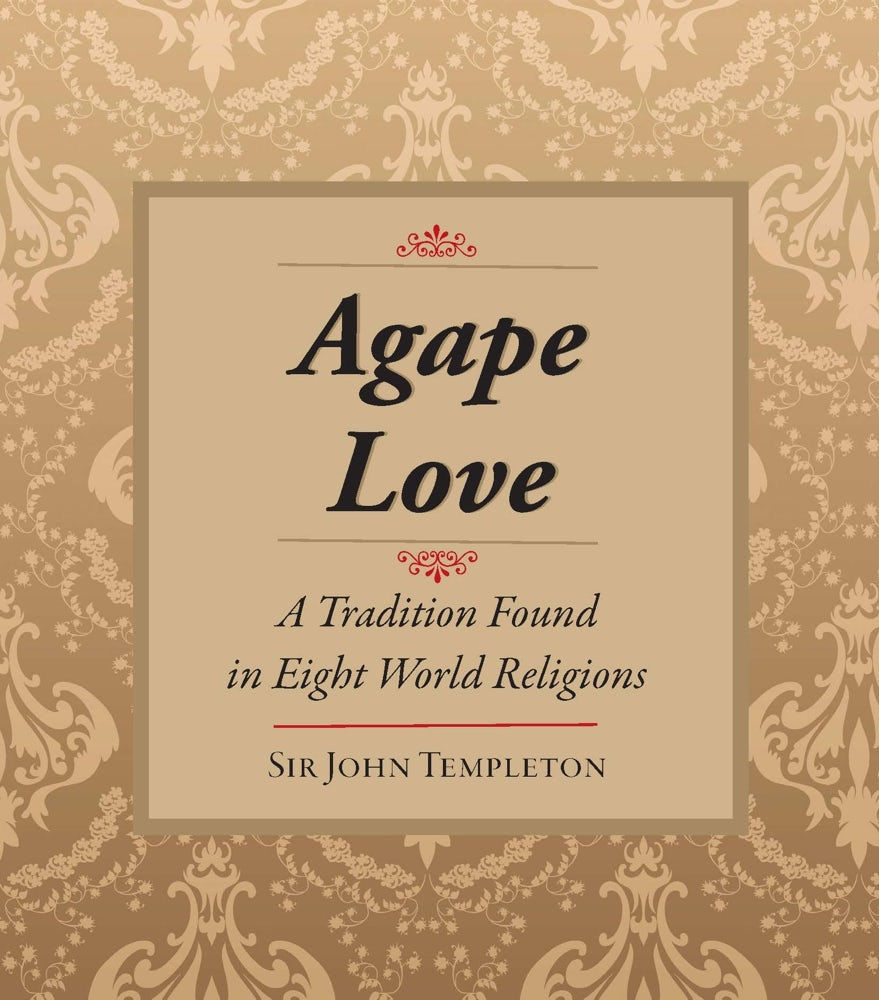
Cover of “Agape Love: A Tradition Found in Eight World Religions” by Sir John Templeton, highlighting love as a unifying principle across faiths.
One aspect of this journey that truly affirmed my own beliefs was recognizing how agapé (unconditional love) lies at the heart of all major spiritual traditions. I was raised Christian, but my life has been enriched by many influences – including a Muslim sister (after her conversion) and friends of various faiths. These experiences taught me not to view religions as rigid, competing silos, but as different interpretations of the same fundamental truths. In fact, the principle of agapé or selfless love is “a primary underlying principle found in religions worldwide.” It challenges believers across traditions to “love without thought of return,” extending compassion, kindness, and charity universally. Buddhism emphasizes a path of compassion for all creatures; Hinduism’s bhakti yoga is about loving the Divine and, by extension, all humanity; even non-theistic philosophies like Taoism or humanism prize altruistic care for others. It’s remarkable – and beautiful – that love is a universal theme found in all religious traditions. When we “realize that all religions have this spiritual principle of love at their core,” we inevitably develop a greater sense of shared humanity rutgersuniversitypress.org.
This realization isn’t just theoretical for me; it’s personal. I once lost a friend because of a clash over religious interpretations – his particular reading of the Qur’an versus my inability to understand his perspective. That loss hurt deeply. In hindsight, I see that ego and misunderstanding (on both sides) got in the way of the compassion our belief systems teach. That experience cemented in me a resolve to put ego aside when it comes to matters of belief. Now, I strive to focus on the common ground – the agapé love and goodness that every creed at its best promotes. So whether one calls it God, Allah, the Universe, or any other name, I believe we’re pointing to the same light. My recent conversation only reinforced this conviction. The author’s message – centering on unconditional love and conscience – sits firmly within those core principles that all my spiritual influences have taught. It was as if he took the diverse threads of my upbringing and life experiences and wove them into a single tapestry of meaning. It’s a message I wholeheartedly support. While you won’t find me proselytizing from the rooftops about it (that’s never been my style), I will carry this perspective into every interaction, speaking about it when it matters most. In my heart, after this exchange, the world does look a little different – a little brighter and more unified – and that answer, for me, is yes.
Agapé in Practice at NDD
Another striking realization from this deep dive was that the work we’ve been doing at NDD (the initiative I’m helping build) has been agapé in action all along – we just didn’t have the terminology for it at first. NDD’s mission, at its core, is to bring people together to improve our communal life (be it in organizations, communities, or even governance) through empathy, understanding, and shared values. In essence, we aim to make democracy shine with the light of conscience and compassiongeorgeallenbooks.substack.com, much like what my author friend advocates. We were already practicing principles of inclusion, deep listening, and respect – treating every participant as inherently worthy and every voice as important. Only now do I recognize that this approach is a form of agapé love applied to group and civic contexts.
The Substack author put it brilliantly in one of his essays: “There should be no misunderstanding that what we are pursuing is agapé in democracy – unconditional, spiritual love – which does not make us vulnerable, because we are never against ourselves at the same time.”georgeallenbooks.substack.com In other words, infusing democracy with unconditional love doesn’t weaken us; it actually prevents the internal divisions that make a society vulnerable. When people see each other as brothers and sisters – bound by that selfless love for the common good – the usual barriers of ego, partisanship, and fear begin to crumble. Mutual respect grows, and even when we disagree, we do so with the understanding that we’re ultimately on the same side. Unconditional love, in practice, means I seek your welfare as much as my own. That ethos has guided NDD’s efforts from the beginning. For example, in our community dialogues, the focus is on hearing and valuing each person’s story, no matter their background or beliefs. This creates a safe space where, over time, mistrust gives way to empathy. It echoes the idea that “the voices of hatred will be silenced when the voices of unconditional love are respected.” In fact, one of George Allen’s recent posts carried that very subtitle – a powerful reminder that love is the antidote to division. In NDD, every time we choose to listen without judgment or extend kindness in the face of anger, we are living out that truth. We’re proving on a small scale what could be true on a large scale: a democracy infused with agapé love is one where unity triumphs over discord.
Shifting Perspectives and Moving Forward
So why am I writing this story? Partly to crystallize the lessons I’ve absorbed from this remarkable confluence of friendship, faith, and an inspiring Substack deep-dive – and partly to share them with both my friend and our wider community. I plan to show him these reflections to let him know how much his quietly loving example means to me (and to give credit to the wonderful conversation that sparked all of this). I suspect he’ll smile and shrug it off in his modest way, but it’s important he knows: his way of being in the world matters. It has ripple effects.
This is also an invitation to anyone reading: to recognize the threads of unconditional love in your own life and work. If you’re curious about the ideas that influenced me, I encourage you to explore the resources that I did. George Allen’s writings, for instance, are a treasure trove for anyone interested in the meeting point of spirituality and democracy (his curated list of posts is a great place to start). The specifics of philosophy or theology might sometimes be challenging, but there’s no mistaking the heart of it: love, compassion, and conscience as drivers of positive change. These are principles that transcend labels – secular or religious, personal or political. They are simply human principles.
As I move forward with our mission at NDD, I do so with a renewed sense of purpose. I carry with me the notion that every step taken in love – no matter how small or quiet – contributes to a more harmonious whole. Neither my friend nor I care about ego or credit; what matters is the impact. And now, with a clearer understanding of agapé, I see our work in a new light. I’ll continue to do what I’ve always done, but with even more conviction that we’re on the right path. After all, as diverse as our backgrounds may be, we are all, at the core, striving to live by the same light of love rutgersuniversitypress.org. Embracing that fact might not make headlines or noise from the rooftops, but it surely changes how we see the world – and yes, I can already tell, I see the world a little differently after this exchange.
Please go read Georges work, for the deepdiving Rabbit-olers like me this is the best post to start with:

References:
Templeton, Sir John. Agape Love: Tradition In Eight World Religions. Templeton Press, 2008 – Description excerpt on universal love across religionsrutgersuniversitypress.orgrutgersuniversitypress.org.
Allen, George. George’s Substack – Tagline and mission statement on “understanding how democracy can shine in the light of our conscience.”georgeallenbooks.substack.com
Allen, George. “The Democracy of our Suneidesis.” George’s Substack, Jul 3, 2025 – Excerpt on pursuing agapé (unconditional love) in democracygeorgeallenbooks.substack.com.
Allen, George. “Spirituality and Democracy 3.” George’s Substack, Mar 13, 2025 – Subtitle: “The Voices of Hatred will be Silenced when the Voices of Unconditional Love are Respected.”georgeallenbooks.substack.com.
I’m humbled sir/ma’am by your kind words, but as you noted, outcomes are always the focus. Such a joy to read about your work putting agapé to practice where it is needed most in reconciliation. It’s moments like this that affirm how people are waking up to what has always been true, seeing beyond the surface joys and welcoming deep joy within and between themselves. But as Word (Christ or Truth depending on our beliefs) said though, there is great reward in loving those who hate us. This is the key to great reconciliation. We are not trying to defeat anyone, only help them open the eyes of their heart as the work of NDD does so well.